
Angel Down by Daniel Kraus
So maybe the Pulitzer team does know something.

I started reading Angel Down when it first came out because it seemed right up my alley. Dark, a little experimental, interesting setting, small group of deep characters, magical elements, the works. About 10 pages in, I put it back down. It was weird and a little hard to read, and while I wasn’t totally turned off, I just wasn’t in the right head space. Then, I kind of forgot about it, even though it was sitting right there on my shelf.
And then, this happened:
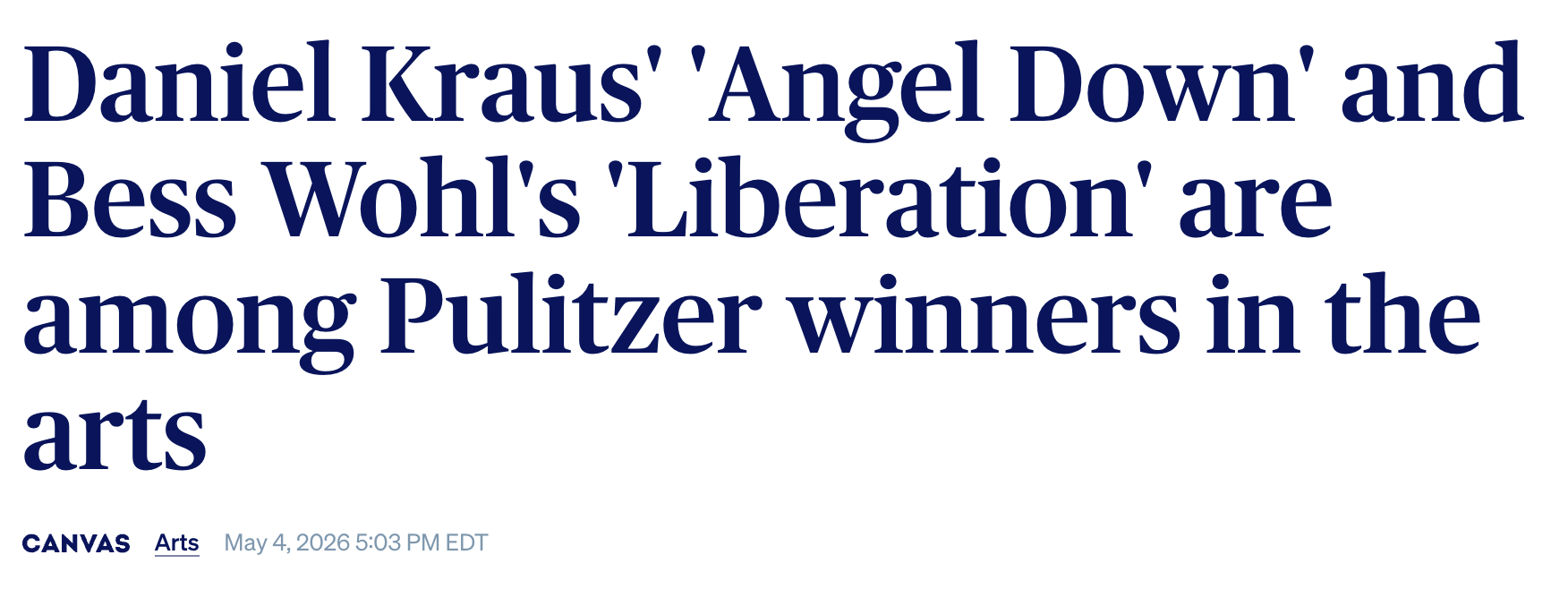
So I thought…I’ll show those Pulitzer yahoo’s who’s boss, I’m going to read this book and hate it!
Joke’s on me.
Quick Take
Angel Down by Daniel Kraus
My rating: ★★★★★ (5/5)
Length: 285pp • Published: July 29, 2025 • Tone: Historical horror thriller magical realism (I said what I said)
In one line: An extraordinary novel that is rewarded for every risk it takes.
Spoiler-Free Summary
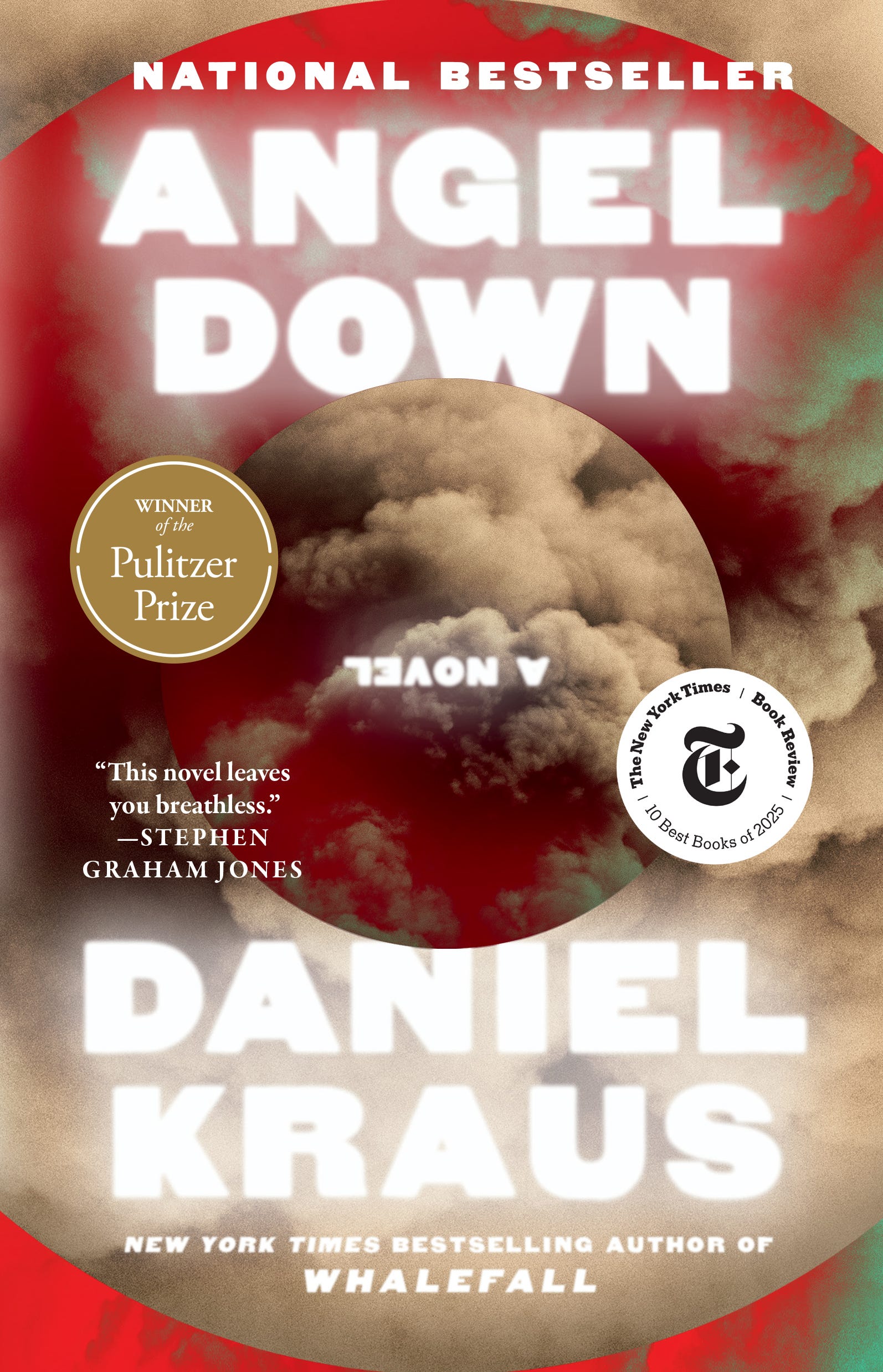
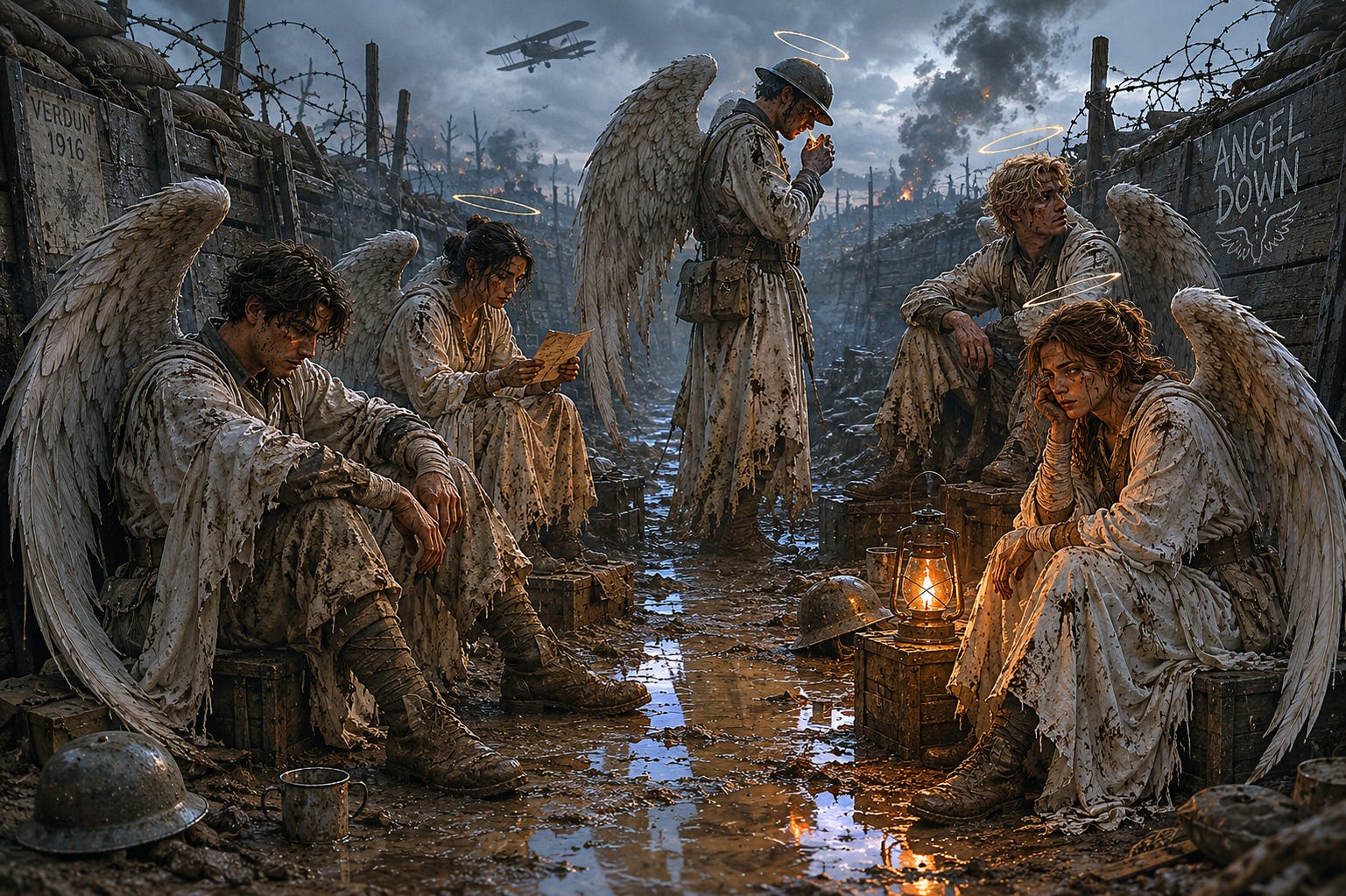
Amidst the nihilistic horror of World War I, Cyril Bagger and four other lowly American soldiers are tasked with a grim mission: find whatever soldier is screaming in the No Man’s Land between the trenches and euthanize him. What Cyril finds is not a wounded soldier, but a fallen angel.
What Worked
Never has a book given me such a intense sense of place. If you let this book grab you, you will feel like you are in the trenches of WWI. Kraus leaves no aspect of it unmentioned; the sights, sure, but also the smell, the sounds, the taste, the mental burden of it all. It all feels exceedingly real. What’s more, you can tell the absurd amount of research put into this part of the novel. There are parts where the soldiers can tell the weaponry bearing down on them by whether they smell cordite or gunpowder. I don’t think I’m doing it justice, but these small, intimate details are presented in such a way that you feel them deep in your chest, if that makes sense.
The craft of writing Angel Down is also extraordinary. I can guarantee it has the least amount of sentences of any Pulitzer winner in history since it has…1. That’s not a typo. The entire 285 page novel is written in one sentence. Though it takes some getting used to (more on that in the next section), once you get going it really lends this urgency and inevitability to the story. It lets you feel the never ending string of one action tumbling into another. Very early on, there’s actually a meta moment where Cyril, as the narrator, says:
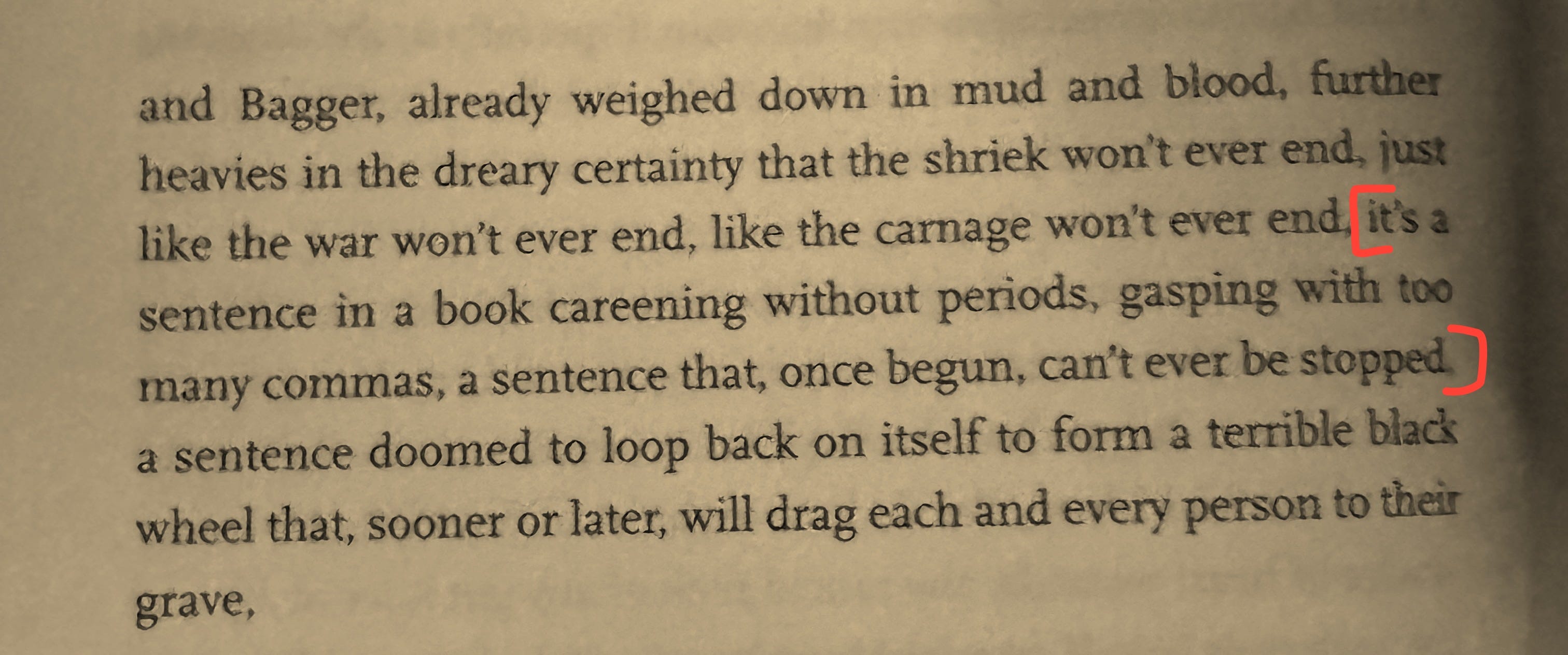
In fact, this speaks to a beautiful thing about Kraus’ writing, which is that he has such an amazing ability to use the form of the words and pages to generate feelings in the reader. Does that track? For example, the whole novel is broken into short, punchy, 2-3 sentence paragraphs that all start with “and” and end in a comma1, but much later on, when Cyril experiences an event beyond his own reckoning, suddenly there is a four page long paragraph that is disorienting to the reader…just as it is to Cyril. Other similar examples abound.
As you can probably tell, I could go on and on, but lets touch on at least two more aspects: the pacing, and the horror. First, the pacing. Typically, novels that are big-L Literary enough to win a Pulitzer are highfalutin, artsy-fartsy. Know what I mean? Long-winded, flowery, in love with their own voice. Not so here. The pacing is so fast, the action nearly relentless, and the language almost all common and down-to-earth. I say almost because now and then Kraus will use a word that you’ve almost certainly never heard of, but always with good reason. In the same way that professional athletes only do fancy moves when they serve the play at hand, and not just to show off2, Kraus tosses these words in there when they are the right words to use. More than once I opened the dictionary to look up what a word meant, and the definition was so spot on that I had no choice but to tip my invisible hat.
Lastly, but certainly not least or the end of an exhaustive list, the horror aspects of Angel Down are more…well…horrifying than any I’ve come across in a long time. Not only is it graphic and pervasive, but the attitude towards it all is so casual because the observers are surrounded by even more unspeakable horrors that it makes it all the more disconcerting to the reader. This is what horror should be. Not just describing how much blood there is a thousand times over, but creating scenes that stay with the reader for long after the final page.3
I feel that this section has been very serious and dripping with sappy praise, so let me restore balance a bit: pee pee, poo poo, fart fart. There we go, brought the level down.
What Didn’t Work
“If you loved the book so much why don’t you marry it why did you put it down the first time?” I hear you asking. Thanks for the question, I’ll elaborate.

The experimental bits of Angel Down require just a bit of time to sink into. If you’re not in the right head space to keep an open mind for the opening chunk, then wait on this one. Wait until you’re ready to give it a chance, because the further you go from a traditional book structure the longer it will take your brain to get into the groove. I promise you’ll be rewarded, but I can also fully understand how sometimes you’re just not ready for that kind of thing. I know, because it happened to me.
Similarly, you need a tolerance for a few scenes that prioritize vibes over clarity. Without giving too much away, and as you might imagine, dealing with a heavenly angel sometimes leads to situations where Cyril doesn’t really understand what he’s seeing, but its more about the feeling of the passage than getting everything going on action by action. You know the kind of reader you are. If that works for you, great. If it doesn’t…be warned.
Memorable Quotes
…for being hated together is so much worse than being hated alone.
Is it, though?
and there’s no battle cry this time, no Reis, no Greisz, no Motta, Chester, no Hollis, no Aquila, no P Company over!, no Butcher Birds advance!, no Bash the Boche!, no Spite the kaiser!, no lies of elation, of glory, of grandeur, of nobility, of triumph, of pageantry, of exaltation, of magnificence, of sublimity, of dignity, of honor, of prestige, of extolment, of idolization, of worship, of rapture, of radiance, of ascendence, of immortality, which leaves only the lie Bishop Bagger might have offered his son if the old man could have broken free of his mind’s prison, the lie of forgiveness,
and the lie goes like this, Bagger tells himself, you deal this one card honestly, my boy, this one single card cleanly off the top of the deck, and maybe all the bad deals of the past will be pardoned,
See what I mean about Kraus’ talent with tempo? Beautiful craft.
…he concluded by accusing his dad of running from failure, the failure of his church, the failure of his faith, “You’re looking for a purpose to save you!” he shouted, to which the Bishop, rather mournfully, replied, “Aren’t you?”,
Oof. Right in the feels.
and its been so long since he’s seen his fathers church that he feels what he always feels when revisiting a childhood haunt, that combination of offense that the place had the temerity to keep existing without him, and awareness that the place has hoarded part of him and only by returning can he reunite with that lost fragment,
If that’s not emotionally true of returning to your childhood home/school/whatever, I don’t know what is.
Final Thoughts
A supernatural horror-thriller is not meant to win the Pulitzer. It just doesn’t happen. And yet…it did. If you read Angel Down, you’ll see why. It is a triumph.
5 Star / 1 Star
Always funny to check the 1 star reviews for something like a Pulitzer winner, but lets start with the 5 as usual before we delve into madness.
Strega Di Gatti gives 5 stars:
For all those that found All Quiet on the Western Front too relaxing, too soothing, there's Angel Down. I don't mean to be insensitive about shellshock, but if there's a book about The Great War that could cause the trembles, it's this one. Daniel Kraus has crafted a novel that's technically one long sentence stuffed with evocative and visceral language. And by visceral, I mean that literal viscera is everywhere.
Ha.
Andrew gives 1 star:
I imagine the pitch for this book looking like a room with the author and some other people in it and he’s like “hey guys I want to write a book in World War I where they FUCKING KILL EACH OTHER INTENSELY and it’s one sentence long and every other word is fuck or poop” and they’re all like wow that sounds kind of very generic to be honest and he’s like “well I can put an angel in if that makes it better” and they’re all like ok.
What exactly does Andrew think happens in war?
Who Should Read This?
Don’t need a flow chart this week: if you can deal with the horrors of war, the supernatural, and some experimental structure, read this book.
Rating
Easy one this week. Angel Down receives 5 out of 5 angels in a trench.
If You Liked Angel Down, You Might Also Like…
Lonesome Dove by Larry McMurtry

I don’t like writing about classics. Recently I’ve read some Vonnegut and similar authors, and you probably won’t see them appear on this Substack. There’s just too many words written about those words, and I don’t know what exactly I could add. I guess I did call The Secret History a modern classic, but I don’t think thats a universally accepted design…
The Great When by Alan Moore

In college, I took a phenomenal course on comics taught by Professor Michael Sharp, and I remember him saying that each year when he revises the syllabus, he changes the books to be read, but one was always present and always will be: Watchmen by Alan Moore
Between Two Fires by Christopher Buehlman
The subject of our withering gaze today is Between Two Fires by Christopher Buehlman, a book that was released in 2012 but is suddenly surging in popularity. Why is that? Are pandemic stories (in this case, the Black Death) suddenly relevant again in a post-COVID world? Are apocalyptic world-threatening battles for our souls touching a certain nerve in …

Thus making the one sentence novel
Usually.
If you’ve read the novel, for me, Veck’s unusual, eh, helmet did the trick. Won’t forget that anytime soon.